
Ultrasound Guided Foam Sclerotherapy (UGFS)
Cost: Our Foam Packages Prices
Our Guarantee: Our foam package prices are fully inclusive with no hidden extras. The package includes 2 treatment sessions for one leg or 3 sessions when both legs are treated. The package also includes medical-grade compression stockings, all follow-up appointments, and any additional injections for residual veins that are needed, there are no additional charges.
Initial 1-hour consultation – £240
Includes full bilateral venous duplex scan, clinical history and examination, a detailed discussion of treatment options, their individual risks and benefits, and a personalized treatment plan. You can book your consultation via our contact page or you can call the Duchy Directly at 01872 438 977.
Foam Package One Leg – £ 1395

Includes foam sclerotherapy to as many veins as needed, all follow-up appointments, all additional top-up treatments, and 24/7 support from your consultant vascular surgeon and vein specialist – Rob Windhaber direct via his mobile.
Foam Package 2 Legs – £ 1995
Includes all the same support as the package for one leg but an additional treatment session may be needed.
Payment terms – outpatient consultations are invoiced after the consultation. All procedures are payable in advance to Ramsay Healthcare (Duchy Hospital). 0% finance is available, you can find out further details by clicking the link or by contacting the Duchy Hospital at 01872 438 974
Tell Me more

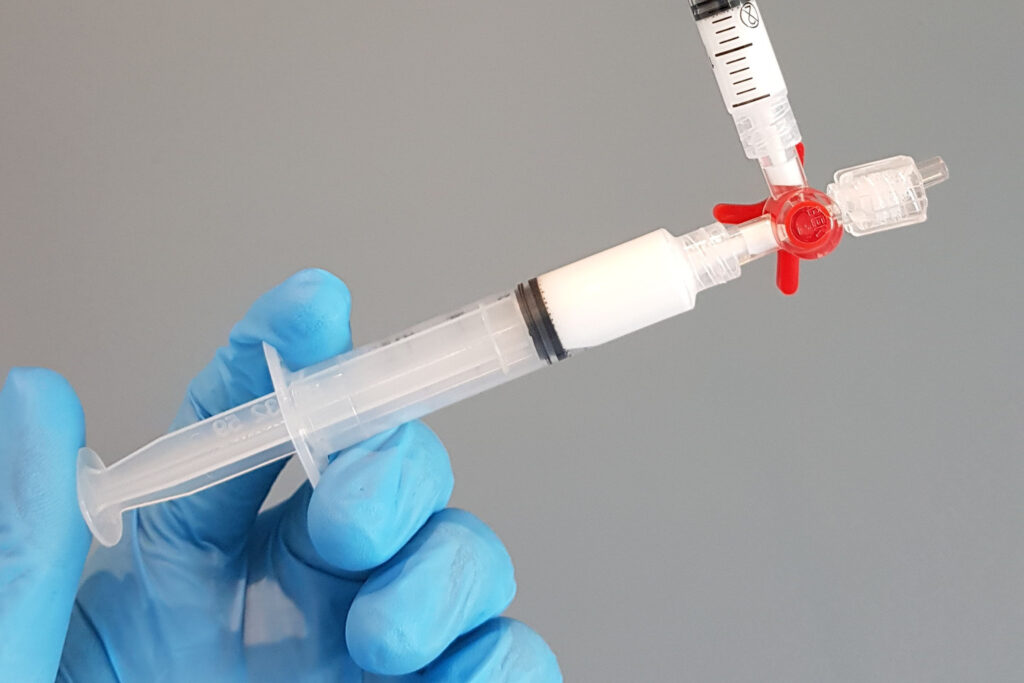
Foam Sclerotherapy, also known as Ultrasound Guided Foam Sclerotherapy, is a medical procedure used for the treatment of varicose veins. It is a modern variation of the traditional sclerotherapy technique, which has been used since 1946 to treat varicose veins. The foam sclerotherapy technique was introduced in 2000 by Dr. Tessari, who developed a method of mixing the sclerosant medication with air or carbon dioxide to create a foam, which could be easily injected into the veins.
Foam sclerotherapy is a non-invasive procedure that can effectively treat varicose veins. The procedure is performed in a comfortable room in the outpatient clinic, not an operating theater, and patients rest on an examination couch. The treatment involves the insertion of small butterfly needles into the affected veins, which are carefully monitored using ultrasound imaging. This ensures that the feeding veins are accurately targeted. No anesthetic injections are usually required, as the needles are so small.
During the procedure, foam is injected into the varicose veins and its progress is closely monitored with ultrasound. The treatment typically takes only a few minutes. After the procedure, a firm bandage or stocking is applied to the leg to keep the veins compressed, reducing the risk of blood filling the veins when the patient stands up.
The treatment is not typically painful, however, patients may experience some mild discomfort or soreness 10-14 days after the procedure. This is known as thrombophlebitis and is a normal part of the healing process. Good compression and, if needed, the aspiration of trapped blood with a small needle can help reduce the severity of thrombophlebitis.
It is normal for multiple injection sessions to be required, with most patients needing 2 sessions for one leg or 3 for both legs. A higher concentration of sclerosant used will result in the closure of more veins, but at the cost of more severe thrombophlebitis. For this reason, it is often preferred to use a lower concentration and accept that a second injection session may be needed. The cost of the procedure includes any additional sessions required.
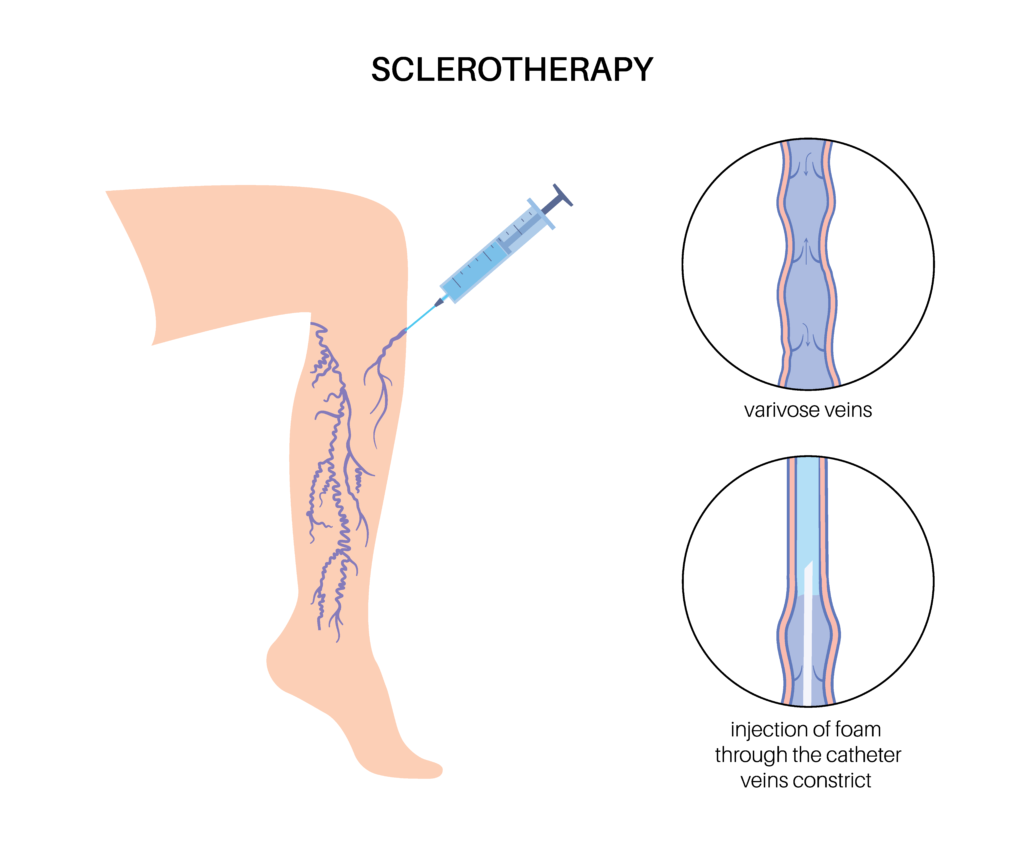
Foam sclerotherapy involves the injection of a foam solution into the affected veins, using a needle guided by ultrasound imaging. The foam solution completely fills the vein, allowing the sclerosant medication to come into contact with the vein wall. The surgeon can control the strength of the sclerosant and the volume of foam injected to achieve the desired effect. The foam causes the lining of the vein to be removed, leading to the closure of the vein channel. Over time, the vein is absorbed by the body.
Foam Sclerotherapy is a safe and effective treatment for individuals with small to moderate-sized varicose veins. NICE Clinical Guideline CG168 has deemed it a suitable option when endothermal treatments such as laser or radiofrequency ablation are not possible. Additionally, feeder veins associated with spider and thread veins can also be treated using foam sclerotherapy.
However, individuals with very extensive or large varicose veins (over 5 or 6mm) may be better suited for alternative treatments, as foam sclerotherapy has a higher risk of complications such as severe thrombophlebitis and skin staining in these cases. Consult with your medical professional to determine if foam sclerotherapy is the right choice for you.
Foam is extremely effective in treating small veins and feeding veins near patches of thread veins. When the foam is used to treat larger veins such as the main superficial veins or large varicosities patients often experience inflammation known as phlebitis, which can lead to brown staining on the skin that takes time to fade. This can be reduced by the use of compression stockings or by removing the trapped blood with a needle in the outpatient clinic a few weeks after the procedure.
Foam is rarely used as a primary treatment for varicose veins on its own but can be used to obtain excellent results when used in combination with other treatments. More information about foam and other vein treatments can be found on the NHS and Circulation Foundation websites.
Foam Sclerotherapy has been approved by the National Institute for Health and Care Excellence (NICE), and is considered safe. Although not as safe as laser treatment, Foam Sclerotherapy has proven to be effective with manageable risks, including:
- Reopening of treated veins (up to 20% if large veins are treated)
- Blood clots in other leg veins (occurring in less than 1% of patients)
- Thrombophlebitis in treated veins (occurring in almost all patients in the first few weeks)
- Visible brown skin staining (most patients experience this, but it fades over 12-18 months)
- Headaches (rarely)
- Temporary vision problems (very rarely)
In extremely rare cases, Foam Sclerotherapy can cause serious potential complications such as strokes or mini-strokes (transient ischaemic attacks) in patients with a heart condition called Patent Foramen Ovale, which occurs in less than 1% of people. These risks can be minimized by limiting the dose in one session and not treating veins larger than 6mm in diameter.
Further Information
You can book your consultation via our contact page, you can email us at: info@windhaber.co.uk or you can call the Duchy Hospital Directly at 01872 438 983.