
Endovenous Laser Ablation (EVLA)
Endovenous laser ablation, commonly referred to as EVLA or EVLT, is considered the gold standard treatment for varicose veins by the National Institute of Health and Care Excellence (NICE CG168) due to its high success rate, and minimal complications.
Whilst not as cheap as some other treatment options, our laser packages provide the best care available and represent excellent value.
Cost: Our Total Care Packages Prices
Our Guarantee: Our laser treatments are guaranteed by Ramsay Total CareTM and our prices are fully inclusive with no hidden extras. If for any reason our treatment does not produce the agreed result then we will treat you again free of charge. The prices below include day case treatment of all agreed veins with “gold standard” Endovenous Laser and any necessary Phlebectomies and foam treatment. All aftercare including Stockings, follow-up appointments and any additional injections for residual veins are included and there are no additional charges.
Initial 1-hour consultation – £240
Includes full bilateral venous duplex scan, clinical history and examination and detailed discussion of treatment options, their individual risks and benefits and a personalised treatment plan. You can book your consultation via our contact page or you can call the Duchy Directly on 01872 438 977.

EVLA (Guaranteed) Package One Leg – £ 2855
Includes EVLA to as many veins as needed, all follow-up appointments, all additional top-up treatments and 24/7 support from your consultant vascular surgeon and vein specialist – Rob Windhaber, direct via his mobile.
EVLA (Guaranteed) Package 2 Legs – £ 3365
Includes all the same support as the package for one leg.
Payment terms – outpatient consultations are invoiced after the consultation. All procedures are payable in advance to Ramsay Healthcare (Duchy Hospital). 0% finance is available, you can find out further details by clicking the link or by contacting the Duchy Hospital at 01872 438 974
Tell Me More
Endovenous Laser Ablation (EVLA) is a cutting-edge procedure that offers a minimally invasive solution for treating varicose veins. This common condition affects millions of people worldwide and can cause both cosmetic concerns and a variety of symptoms such as pain, swelling, and cramping.

EVLA is highly effective because it addresses the underlying condition that causes varicose veins by using laser energy to heat and seal the affected vein, restoring healthy blood flow to the legs. This results in both an improved appearance of the veins and a reduction of associated symptoms.
One of the major benefits of EVLA is that it is performed on an outpatient basis, so patients can have the procedure done and return home the same day. The laser fibre is very fine (400µm) and is inserted into the vein through a small drip needle under local anaesthetic. The veins are then surrounded with a dilute local anaesthetic solution. The whole procedure is comfortable and very quick only taking about 30 min per vein and typically the whole procedure (including adjunctive foam and phlebotomies) takes no more than 1 to 2 hours, depending on the number of veins being treated.
Laser is extremely versatile and can be used to treat quite short segments of veins that most other techniques cannot. This is particularly important when treating complex or recurrent varicose veins. Laser treatment also has the lowest recurrence rate of all the currently available techniques. Only about 3% of veins treated with EVLT veins reopen by 5 years. The only drawback to this technique is that some patients experience slightly more discomfort after this procedure than those patients who undergo Radiofrequency Ablation. The discomfort is normally mild and most patients do not even require paracetamol. The recovery following EVLA is generally comfortable, with some mild discomfort and swelling expected in the first few days post-procedure, which can be managed with over-the-counter pain medication.
Overall, EVLA is a safe and highly effective option for treating varicose veins. It offers a long-term solution that improves both the appearance of the legs and associated symptoms. With EVLA, you can confidently say goodbye to unsightly varicose veins and enjoy improved leg health and appearance.You can read NICE guidance on endovenous laser therapy for the long saphenous vein IPG52 here:
On the day of treatment, you will be admitted to one of our day case rooms by a member of the Day surgery nursing staff. They will run through the pre-procedure checklist and then Rob Windhaber (Consultant Vein Specialist) will come and have a chat with you to make sure you have had all your questions answered and that nothing has changed since your outpatient consultation. He will also mark any superficial lumpy veins that will be treated, as these often disappear once you lay down in the treatment room. He will ask you to complete 2 consent forms, one for the procedure and a separate form for the local anaesthetic.
It is normally a good idea to bring some reading material or an electronic device to keep you relaxed and pass the time before you have your treatment. Other things to consider bringing are loose-fitting clothing to put over the bandages and a change of underwear, in case you get ultrasound gel or cleaning solution on them. You will also be given a disposable gown to wear and written post-procedure instructions, including Rob’s mobile phone number and e-mail address in case you have any questions or would like advice after the operation.
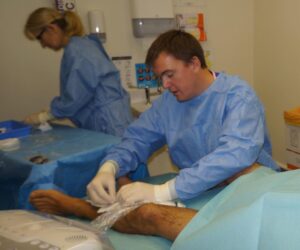
You will then be walked to the day case treatment room by a member of the Day surgery nursing staff where you will be introduced to the team and they will do further checks. You will then be asked to lie on a treatment couch and your leg will be cleaned with an antiseptic solution and covered with drapes. Depending on which veins are to be treated, you may be on your back or your front.
Rob will carry out the procedure himself, assisted by two or three members of the Day surgery nursing staff. A member of the nursing team will be at your side to offer reassurance and monitor your well-being during the procedure. You are welcome to talk to Rob during the procedure, ask him any questions and let him know if you are uncomfortable at all.
Endovenous means inside the vein, so the next thing Rob has to do is to insert the fine laser fibre into the vein. A small amount of local anaesthetic is injected into the skin and once the skin is numb, a needle is inserted into the vein. Through this needle, a fine laser fibre is inserted into the vein to be treated. These steps in the procedure are guided by ultrasound. Once the laser fibre is in the correct position, as confirmed by ultrasound, the vein is numbed by a series of local anaesthetic injections with a fine needle.
You will be asked to put on laser safety goggles as a precaution. The laser is then activated and the laser fibre is gently withdrawn along the length to be treated, the vein is sealed, cauterised and sterilised. You should not feel the laser treatment at all. If you are having both legs treated, the process is repeated on the other leg. The laser is removed and the needle puncture is covered with a small dressing.
Whilst laser is almost universally recognised as the “Gold Standard” treatment, the best results can be achieved when laser treatment is performed in combination with other treatments such as phlebectomy or foam. Whilst EVLA effectively closes the main refluxing veins, it cannot treat the very superficial varicose veins under the skin. It is therefore normal to have phlebectomy and/ or foam sclerotherapy performed in addition. This is all included in the treatment package, and unlike some vein centres, we do not make additional charges for this. The whole procedure normally takes 1-2 hours, depending on how extensive your veins are and if you are having one or two legs treated. After your leg is treated, a large padded bandage is applied and you will be given a stocking to take home.
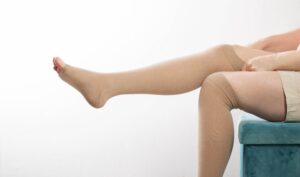
It’s important to note that post-procedure, you should avoid strenuous activity for the first week and should wear the compression stocking for a minimum of 1 week to help with healing and to prevent blood clots. The stockings can be worn for longer than one week if they feel supportive and comfortable. You will be given instructions on how to care for the treated area and how to manage any mild swelling or discomfort that you may experience. You will also be given Rob’s mobile phone number and e-mail address in case you have any concerns post-procedure.
It’s also important to note that although the EVLA procedure is a highly effective treatment for varicose veins, it’s not a permanent cure. The underlying condition that caused the varicose veins in the first place, such as weak or damaged valves in the veins, is not corrected. Therefore, it’s possible that new varicose veins may develop in the future. Regular check-ups with Rob or another vein specialist will help to monitor your progress and address any new issues that may arise
As well as the experience and skill of your surgeon, one of the primary considerations in EVLA is the type of laser fiber used. The original bare fiber laser is a simple, single-fiber laser that delivers energy. While these fibers have been used successfully in the past, they have certain limitations. For example, they can break and be left in the patient, and they require a sheath to be inserted into the patient, making them less versatile and struggling to treat complex veins such as shorter vein segments and perforator veins. Additionally, bare fibers can cause more pain during and after the procedure.
In contrast, radial firing lasers, such as the Neolaser Corona 360 Fused™, offer several advantages over bare fibers. These lasers have multiple fibers that radiate from a central point, allowing for better control and precision during the procedure. They also do not require a sheath to be inserted into the patient, making them more versatile and easier to use on shorter vein segments and perforators. Perhaps most importantly, radial firing lasers have been shown to reduce post-procedural pain compared to bare fibers. This is because they use lower power to achieve the same effect, leading to fewer perforations of the vein wall and less post-procedure pain and bruising.
The Neolaser™ 1470nm laser generator uses a shorter wavelength compared to the earlier 810nm and 980nm lasers. This shorter wavelength targets water in the vein wall to produce steam, which causes the vein to collapse and close, rather than targeting blood like the original lasers. This requires lower power and results in fewer perforations of the vein wall, leading to less post-procedural pain and bruising.
Whilst some clinics use older laser machines and bare laser fibers for primarily economic reasons, at Veincare Cornwall, we only use the latest Neolaser™ 1470 laser generator and the Neolaser Corona 360 Fused™ laser fibers. This ensures that our patients are provided with the most comfortable and effective treatment possible.
In conclusion, the type of laser and the fiber used in EVLA is a critical consideration, with radial firing lasers, such as the Neolaser Corona 360 Fused™, offering several advantages over bare fibers, including reduced post-procedural pain, better control and precision, and increased versatility. At Veincare Cornwall, we are committed to using the latest and most advanced technology to provide our patients with the best possible results.
After your endovenous laser ablation treatment, you will be kept under observation for around 30 minutes, to ensure that you are feeling comfortable and that your dressings are in good condition before you are able to go home. Your Consultant and vein specialist – Rob Windhaber will also provide you with a written advice sheet containing important telephone numbers that you can contact in case you have any concerns or questions.
It is advisable not to drive immediately after your treatment, and we recommend that you arrange for a friend or relative to give you a lift home. The bandages on your legs are worn overnight, and should be removed the following morning. These bandages can be disposed of in a standard kitchen rubbish bag. You will be able to shower and dry your legs before putting on the compression stockings that you have been provided with. These stockings should be worn during the day for 1 week, however, you are free to remove them at night if you feel more comfortable. You may choose to wear them for longer if you feel that it is beneficial, but there is no medical requirement to wear them beyond 1 week.
After your treatment, there are only a few restrictions to keep in mind:
- Wait until you feel confident and comfortable enough to perform an emergency stop before driving again.
- Avoid flying for 2 weeks before surgery and ideally 6 weeks afterwards.
- Avoid activities that make your legs hot, such as vigorous aerobic exercise or saunas.
- Walking is encouraged, but try to avoid excessive exercise for about 2 weeks. Listen to your body and rest when needed.
- Some patients may experience a tightening sensation along the treated vein or mild pain around 5 days after treatment. This is usually mild and can be relieved with over-the-counter anti-inflammatory drugs like ibuprofen.
Our team is available to provide support and guidance throughout your recovery. If you have any concerns or questions, please don’t hesitate to reach out to us.
There are no stitches needed during this procedure. The treatment is carried out through small pricks or punctures in the skin. These punctures are only about 1mm and they are covered by a small adhesive dressing which you remove 24-48 hours later.
We follow NICE guidance that recommends that compression stockings should be worn for 7 days after vein treatment. There is no medical need to wear the stockings longer than this. Many people find it comfortable to wear the surgical stocking in the daytime for another week or two, this is entirely fine if it feels more comfortable.
The recovery time after endovenous laser ablation (EVLA) is generally fast. Most patients can return to their normal activities, including work, within a day or two. However, if the varicose veins treated are extensive, foam is used or if phlebectomy is performed in conjunction with the EVLA, it may be necessary to take a few extra days off work. To speed up recovery and minimize discomfort, patients are typically advised to walk frequently, wear compression stockings, and avoid strenuous activities for a period of time following the procedure. Additionally, over-the-counter pain relievers and anti-inflammatory medications as well as elevating the legs as much as possible during the recovery period.
We treat all veins comprehensively at the time of initial treatment, however, with extensive veins it is likely that not every single vein will resolve completely.
If you are having treatment just to relieve symptoms or to treat a complication such as varicose eczema, phlebitis or leg ulceration, then no further treatment is usually necessary. Most patients however wish also to improve the appearance of their veins and of these about 80-90% will require a small amount of additional treatment.
At Veincare Cornwall, working with The Duchy Hospital, we have developed a comprehensive treatment package for your veins to ensure that you get the best possible outcome. This means that you can be seen in the outpatient clinic and any residual veins can be injected at no additional cost. This process can be repeated as many times as needed to achieve the desired result again at no additional cost.
EVLA, or Endovenous Laser Ablation, is a highly effective and minimally invasive treatment option for varicose veins. It boasts a high success rate and has been shown to be a safe procedure with a low risk of complications.
One of the most common complications associated with EVLA is thrombophlebitis, which is an inflammation of the vein wall. This is a normal part of the healing process and symptoms such as tenderness and hardening of the treated vein, as well as varicose veins that feed from the treated vein may become hard and lumpy, typically resolving over a few weeks.
Nerve damage is another potential complication, but this is also rare. Small patches of numbness on the skin may occur but usually resolve over a few months.
Burns are an extremely rare complication, as the laser used in EVLA is highly precise and carefully calibrated to avoid burning the skin. The risk of deep vein thrombosis (DVT) is also low, but it is a recognized complication of surgery and can be dangerous if the clot breaks away and travels to the lungs. The risk of getting a DVT after EVLA is very low but has been reported, the risk is less than 1 in 200 for most people.
Overall, EVLA is a safe and effective treatment option for varicose veins. It’s important to be aware of the potential risks and complications associated with the procedure so that you can make an informed decision about whether it is right for you. With the high success rate and low risk of complications, EVLA can be a great solution for those looking to get rid of varicose veins.
Further Information
You can book your consultation via our contact page, you can email us at: info@windhaber.co.uk or you can call the Duchy Hospital Directly on 01872 438 983.