Radiofrequency Ablation (RFA/ VNUS)
Our Promise: Our radiofrequency ablation treatments are backed by Ramsay Total CareTM and our prices are all-encompassing with no added surprises. Should our treatment not produce the expected outcome, we will provide a repeat treatment at no extra cost. The prices listed below include day case treatment for all targeted veins with the “gold standard” VNUS (Radiofrequency Ablation) method, as well as any necessary phlebectomy and foam treatments. All aftercare, including compression stockings, follow-up appointments, and any additional injections for residual veins are included with no hidden fees.
Initial Consultation (1 Hour) – £240:
This includes a comprehensive bilateral venous duplex scan, a review of your medical history and physical examination, and a personalized treatment plan that includes a detailed discussion of available treatment options, the risks and benefits associated with each, and a tailored approach to your specific needs. You can schedule your consultation through our contact page or by calling the Duchy Hospital directly at 01872 438 977.
VNUS (Guaranteed) Package for One Leg – £2855:
This package includes VNUS treatment for any number of veins needed, all follow-up appointments, additional top-up treatments as required, and round-the-clock support from your consultant vascular surgeon and vein specialist, Rob Windhaber, who is easily accessible via his mobile phone.
VNUS (Guaranteed) Package for Two Legs – £3365:
This package offers the same level of support as the package for one leg.
Payment Terms: Outpatient consultations are invoiced after the appointment. Payment for procedures must be made in advance to Ramsay Healthcare (Duchy Hospital). Financing options with 0% interest are available, and further details can be obtained by clicking the link or contacting the Duchy Hospital at 01872 438 974.
Radiofrequency Ablation (RFA) is a minimally invasive solution for treating varicose veins. If you’re suffering from varicose veins and are seeking a straightforward treatment option, RFA could be the answer you’re looking for.
RFA works in a similar way to Endovenous Laser Treatment (EVLT). Both treatments use heat to seal the damaged vein from the inside. However, the heat energy used in RFA is generated by microwave technology in the catheter, allowing for a constant adjustment of the energy delivered to the catheter. This helps to prevent hot spots in the treated vein and reduces post-procedural discomfort.
The RFA catheter is slightly larger than the laser fiber used in EVLT, and a slightly larger needle is required for insertion. However, like that of EVLT (3%), the recurrence rate for RFA is extremely low, with less than 5% of treated veins experiencing recurrence within 5 years. Whilst Endovenous Laser has advantages over RFA for most patients, RFA can be a good choice for patients (with straightforward veins) looking for the least post-operative discomfort and the fastest return to normal.
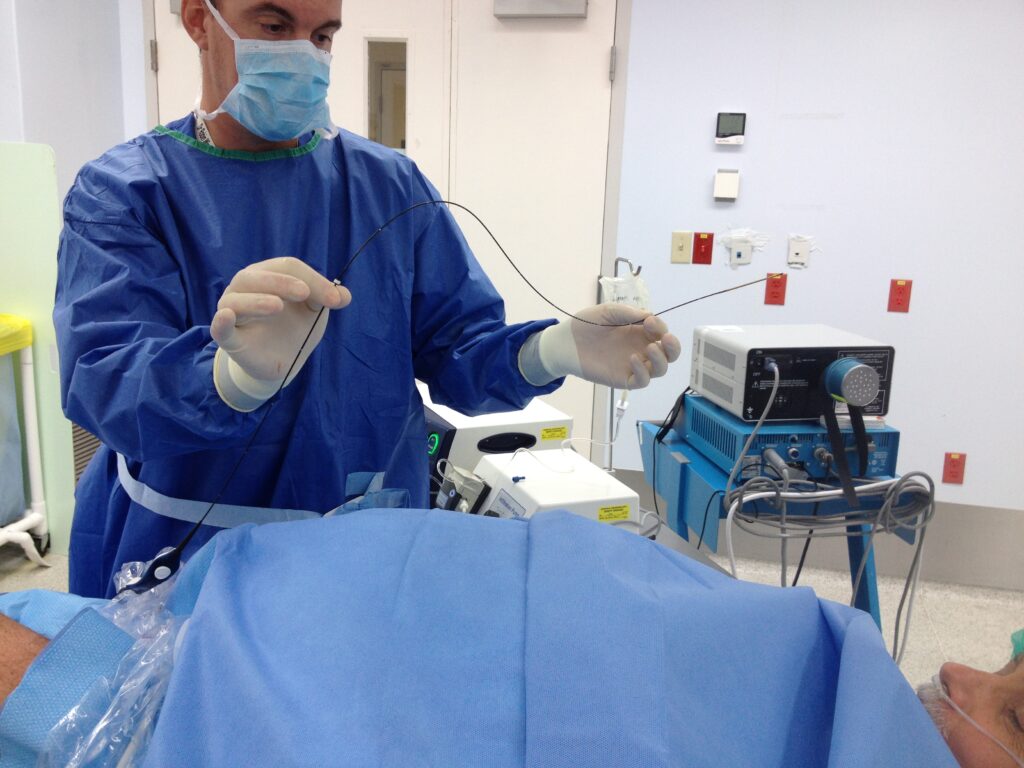
The procedure is performed under local anaesthesia and usually takes 45-60 minutes although most patients also have additional procedures such as phlebectomy or sclerotherapy at the same time so the total procedure may take longer. Your surgeon places a small needle into your lower leg under ultrasound and a small tube through which he inserts the RFA catheter into the affected vein. The catheter is then used to heat the inner wall of the vein, causing it to shrink and eventually close. Once the vein has been closed, blood will naturally be redirected to other healthy veins in your leg, ensuring proper circulation.
Radiofrequency ablation (RFA) is a minimally invasive procedure used to treat varicose veins. It was first introduced in the medical field in the early 1990s as an alternative to surgical stripping.
RFA uses high-frequency radio waves to heat and shrinks the affected veins, causing them to collapse and close. The procedure is performed through a small incision and can be done under local anaesthesia. The first RFA catheter used for treating varicose veins was a simple, single-electrode device that has since evolved into multi-electrode catheters offering greater precision and control.
Today, RFA along with Laser is considered the gold standard for treating varicose veins and is the recommended first-line treatment for most types of varicose veins. It is a safe and effective treatment option that offers patients a faster recovery time, less pain, and fewer complications compared to traditional surgical methods.
Leading manufacturers of RFA devices for the treatment of varicose veins include Covidien (now part of Medtronic), Venefit, AngioDynamics, and Merit Medical Systems. These companies are constantly improving their RFA devices to make them safer, more effective, and easier to use for patients and healthcare providers.
The history of RFA for treating varicose veins is a testament to the evolution of medical technology and its ability to provide patients with better, less invasive treatment options.
On the day of your Radiofrequency Ablation (RFA) treatment, you’ll be admitted to a day surgery room. A member of the nursing staff will go over the pre-procedure checklist and you will be given a disposable gown to wear. He’ll have a chat with you to make sure you have all your questions answered and mark any veins that will be treated. He’ll also have you sign two consent forms, one for the procedure and one for the local anaesthesia.
It’s recommended to bring reading material or an electronic device, loose-fitting clothing to wear over the bandages, and a change of underwear. Rob will give you written post-procedure instructions, including his phone number and email in case you have any questions or concerns after the procedure.
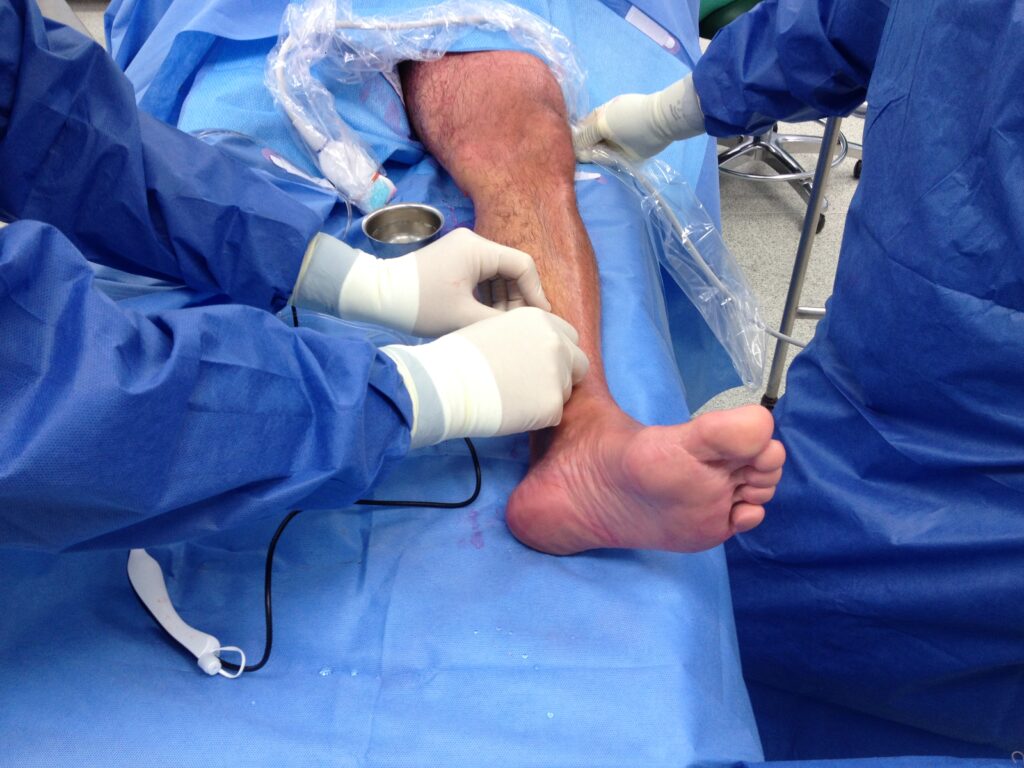
You will then be walked to the day case treatment room by a member of the day surgery nursing staff where you will be introduced to the team and they will do further checks. You will then be asked to lie down on a treatment couch, and your leg will be cleaned with an antiseptic solution and covered with drapes. Depending on which veins are to be treated, you may be on your back or front.
Rob will perform the procedure himself, assisted by two or three members of the day surgery nursing staff. A member of the nursing team will be at your side to offer reassurance and monitor your well-being during the procedure. You can talk to Rob during the procedure, ask questions, and let him know if you are uncomfortable at any time.
A small amount of local anesthetic is injected into the skin, and once the skin is numb, a needle is inserted into the vein. Through this needle, a fine RFA catheter is inserted into the vein to be treated. These steps in the procedure are guided by ultrasound. Once the catheter is in the correct position, as confirmed by ultrasound, the vein is numbed by a series of local anesthetic injections with a fine needle.
You will be asked to put on laser safety goggles as a precaution. The RFA energy is then activated, and the catheter is gently withdrawn along the length to be treated. The vein is sealed, cauterized, and sterilized. You should not feel any discomfort during the procedure. If you are having both legs treated, the process is repeated on the other leg. The catheter is removed, and the needle puncture is covered with a small dressing.
After your leg is treated, a large padded bandage is applied, and you will be given a compression stocking to wear at home. It’s important to avoid strenuous activity for the first week and wear the compression stocking for at least one week to help with healing and prevent blood clots. The stockings can be worn for longer if they feel supportive and comfortable. You will receive instructions on how to care for the treated area and manage any mild swelling or discomfort you may experience. You will also receive Rob’s mobile phone number and email address in case you have any concerns post-procedure.
After your RFA treatment, you’ll be monitored for about 30 minutes to make sure everything is okay. Your consultant and vein specialist, Rob Windhaber, will also provide you with a written advice sheet with important phone numbers in case you have any questions or concerns.

It’s best to arrange for a ride home as you shouldn’t drive immediately after your treatment. You’ll need to wear the bandages on your legs overnight and remove them the next morning. You can shower and dry your legs before putting on the compression stockings provided. Wear them during the day for one week, but feel free to take them off at night if you prefer.
Here are a few things to keep in mind after your treatment:
- Wait until you’re confident and comfortable enough to perform an emergency stop before driving.
- Avoid flying for two weeks before the procedure and ideally six weeks after.
- Avoid activities that make your legs hot, such as vigorous exercise or saunas.
- Walking is encouraged, but try to avoid excessive exercise for about two weeks and listen to your body, taking rest when needed.
- Some patients may experience a tight feeling along the treated vein or mild pain around five days after treatment. This is usually mild and can be relieved with over-the-counter anti-inflammatory drugs such as ibuprofen.
If you have any concerns or questions, Rob Windhaber and his team are here to support you throughout your recovery. Don’t hesitate to reach out to them.
The recovery after Radiofrequency Ablation (RFA) is typically quick. Most patients can get back to their normal routine, including work, within a day or two. If the treated varicose veins are extensive or if other treatments like foam or phlebectomy are performed with RFA, it may require a few extra days off work. To aid recovery and reduce discomfort, patients are usually recommended to walk regularly, wear compression stockings, and avoid strenuous activities for a while after the procedure. Additionally, taking over-the-counter pain relievers and anti-inflammatory drugs, as well as elevating the legs as much as possible during the recovery period, can help speed up the process.
At Veincare Cornwall and The Duchy Hospital, we follow the guidelines set by the National Institute for Health and Care Excellence (NICE) for post-vein treatment care. According to NICE, compression stockings should be worn for 7 days after the vein treatment. While there is no medical requirement to wear the stockings for longer than 7 days, many patients find it comfortable to continue wearing them during the daytime for an additional week or two. The decision to continue wearing the stockings is completely up to the individual’s comfort level.
At Veincare Cornwall and The Duchy Hospital, our goal is to provide you with the best possible outcome for your varicose veins treatment. That’s why we offer a comprehensive radiofrequency ablation (RFA) treatment package to ensure that all veins are treated thoroughly.
While some veins may not resolve completely after the initial RFA treatment, you’ll find relief from symptoms such as varicose eczema, phlebitis, or leg ulceration. If you’re looking to improve the appearance of your veins, 80-90% of patients require some additional treatment.
Our comprehensive treatment package means that any residual veins can be treated during outpatient appointments at no extra cost, and as many times as needed to achieve the desired result. This way, you can feel confident in your results and your overall experience with Veincare Cornwall and The Duchy Hospital.
Radiofrequency ablation is a popular and minimally invasive treatment option for varicose veins. While it boasts a high success rate, it is important to understand the potential risks associated with the procedure. These risks are very rare but important to know about. All Robs patients are given his contact details and mobile phone number so if it ever did occur a complication could be treated promptly.
Vein Puncture: A small puncture is made in the leg to allow the insertion of the RFA catheter. In rare cases, the puncture site may not heal properly and can cause a small tear in the vein (less than 1% of cases). This is typically treated with a simple dressing change and heals within a few weeks.
Blood Clots: Blood clots are a rare but recognized complication of RFA (less than 0.5% of cases). Although the risk is low, if a blood clot occurs, it can be serious. Symptoms include swelling, warmth, and pain in the affected leg, and if left untreated, it can travel to the lungs and cause a potentially life-threatening condition known as a pulmonary embolism.
Pulmonary Embolism: A pulmonary embolism is a blood clot that travels from the leg to the lungs (less than 0.5% of cases). Symptoms include shortness of breath, chest pain, and a rapid heartbeat. If you experience these symptoms, it’s important to seek medical attention immediately.
Phlebitis: Phlebitis is an inflammation of the vein wall and is a normal part of the healing process after RFA (less than 5% of cases). Symptoms can include tenderness, hardening of the treated vein, and varicose veins becoming hard and lumpy. These symptoms typically resolve within a few weeks.
Hematoma: A hematoma is a collection of blood that can occur at the puncture site after RFA (less than 1-2% of cases). It can cause swelling, pain, and discoloration of the skin. Hematomas are typically treated with a simple dressing change and resolve within a few days.
Infection: Infections are extremely rare after RFA (far less than 1% of cases), but if they occur, they can cause redness, swelling, and warmth at the puncture site. If you develop an infection, it’s important to seek medical attention so that it can be treated promptly.
Burning of the Skin: Burns are an extremely rare complication of RFA (less than 1% of cases), as the technology used is highly precise. If you experience any burning or discomfort during the procedure, it’s important to let your doctor know.
It’s important to remember that this procedure may not be appropriate for patients with pacemakers or implantable cardiac devices. Before considering RFA, it’s crucial to discuss the procedure with an experienced vein specialist to ensure that it’s the right choice for you.
Despite these potential risks, RFA boasts a high success rate and has been shown to be a safe procedure with a low risk of complications. If you’re seeking a straightforward treatment option for varicose veins, RFA could be the answer. With its high success rate and low risk of complications, RFA can be a great solution for those looking to get rid of varicose veins. If you’re interested in learning more about RFA and how it could help, you can call the Duchy Hospital at 01872 438 983.
Read NICE guidance on Radiofrequency Ablation for the long saphenous vein IPG8
Further Information
To book your consultation you can: contact us via our contact page, email us at: info@windhaber.co.uk or call the Duchy Hospital Directly at 01872 438 983.